For startups, growing businesses, and enterprise teams

A Software Development Team Built for the AI Era

Build software with a governed virtual development team that can plan, develop, test, document, deploy, and continuously improve your applications.

VDT combines specialized AI team members, development tools, defined workflows, security controls, and human oversight into one managed development environment.

Your team. Your tools. Your code. Your control.

The Problem

AI Can Write Code. That Doesn't Mean You Have a Development Team.

Companies now have access to powerful AI coding tools. But someone still has to:

  • Decide what should be built
  • Define requirements
  • Choose the architecture
  • Manage development tasks
  • Review code
  • Test the software
  • Manage GitHub
  • Deploy applications
  • Track documentation
  • Monitor security
  • Keep AI tools and models current
  • Make sure autonomous systems remain under control

For many organizations, AI has simply moved the management burden somewhere else. VDT is designed to remove that burden.

From managing AI tools to managing outcomes.

What Is VDT?

A Governed Virtual Development Team

A VDT is a group of specialized AI development agents operating inside a controlled development environment.

Each team member has

  • A defined role
  • Defined responsibilities
  • Its own working environment
  • Approved tools and permissions
  • Project memory and instructions
  • Communication rules
  • Escalation procedures
  • Development standards
  • Security boundaries

The agents work together through the same systems development teams already use, including GitHub, project management, team communication, testing systems, development environments, and cloud platforms.

The goal is not to replace good software-development practices.
The goal is to apply those practices to AI development teams.

Meet the VDT

Six Roles. One Governed Team.

VDT members are specialized because software development works better when responsibilities are clear.

Avery Bennett

Avery Bennett

Business Analyst / Solution Architect

Turns business goals into requirements, workflows, technical plans, and development tasks.

Jordan Mercer

Jordan Mercer

Technical Lead / Senior Engineer

Oversees architecture, code quality, engineering decisions, pull requests, and technical direction.

Taylor Brooks

Taylor Brooks

Software Engineer

Builds features, fixes defects, writes tests, updates code, and maintains project branches.
Casey Morgan

Casey Morgan

QA / Test Engineer

Tests applications, validates requirements, identifies defects, and verifies releases.

Riley Carter

Riley Carter

DevOps / Infrastructure Engineer

Manages development environments, deployments, infrastructure, CI/CD, and operational reliability.

Morgan Ellis

Morgan Ellis

Documentation / UX Engineer

Maintains technical documentation, reviews UX, and makes sure development knowledge is captured.
How VDT Works

An 8-Step Process, Not a Prompt

Work moves through the same discipline a strong human development team follows.

1

Understand

The Business Analyst reviews the business requirement and turns it into a defined development objective.

2

Plan

The Architect and Technical Lead define architecture, requirements, dependencies, and development tasks.

3

Build

Software Engineers work through assigned tasks using approved development environments and coding models.

4

Review

Code is committed to GitHub and reviewed through established pull-request and approval processes.

5

Test

QA performs automated and functional testing before work is accepted.

6

Deploy

DevOps manages approved deployments and infrastructure changes.

7

Document

Project decisions, features, systems, and operating procedures are maintained as the product changes.

8

Improve

VDT tools, models, skills, development standards, and security controls are periodically evaluated and updated.

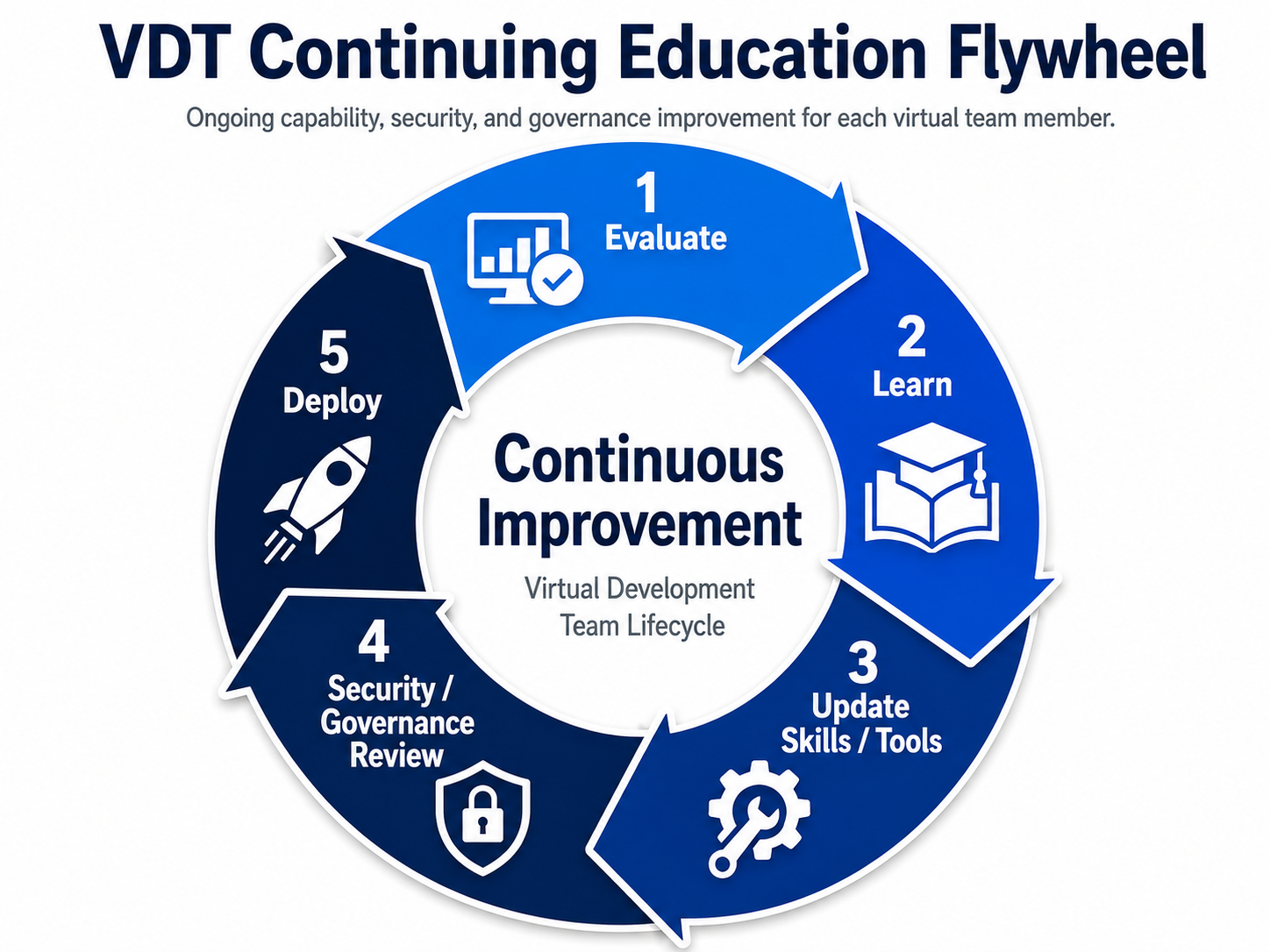
VDT Continuing Education Flywheel: Evaluate, Learn, Update Skills and Tools, Security and Governance Review, Deploy
Three Customer Paths

One Product. Three Ways to Deploy It.

The core VDT is consistent — how it's introduced and governed changes by stage.

Startups

Build the Product Without Building the Development Department

You bring the business idea. VDT provides the development operating model.

VDT for Startups →
Small Business

Add Development Capacity Without a Large Internal Technology Team

Your technology capability can grow before your technology payroll does.

VDT for Small Business →
Enterprise

Governed AI Development Capacity for the Enterprise

Enterprises usually don’t have an AI-access problem. They have an AI-control problem.

Discuss Enterprise VDT →
Governance

AI Agents Need More Than Prompts

When AI systems begin taking actions instead of simply answering questions, organizations need controls around what those systems are allowed to do.

Identity

Every VDT team member operates under an assigned identity.

Role

Each team member has defined responsibilities.

Access

Agents receive only the systems and permissions required for their work.

Communication

Defined systems determine how agents communicate with humans and other VDT members.

Authority

Important actions can require approval before execution.

Audit

Development work passes through systems such as GitHub, project management, and deployment records.

Escalation

VDT members know when an issue should be passed to another agent or a human.

Lifecycle Management

Models, skills, tools, security practices, and operating procedures are continually reviewed.

Autonomy without governance creates risk. Governance without useful autonomy defeats the purpose of AI. VDT is designed to balance the two.

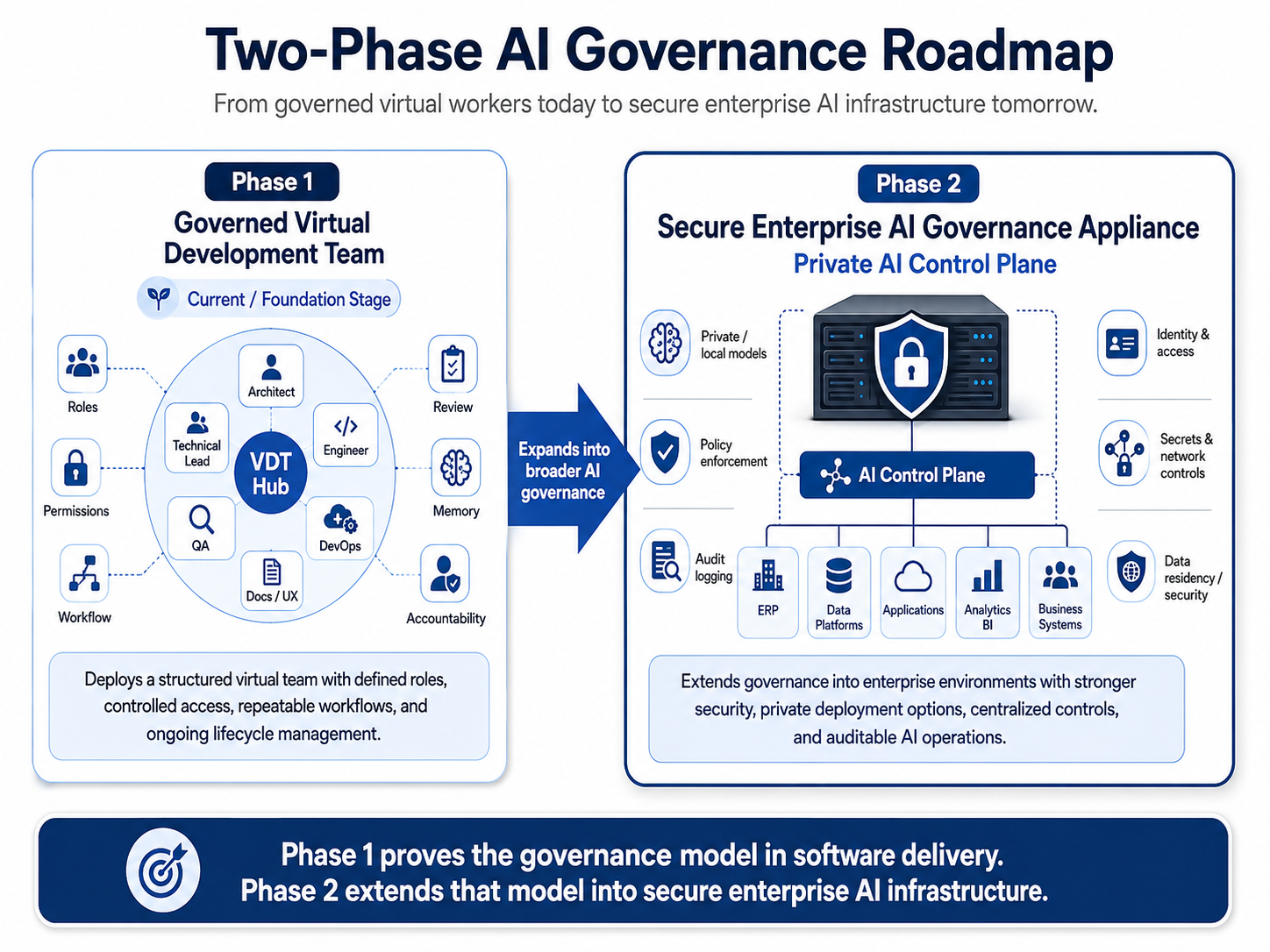
Two-Phase AI Governance Roadmap: Phase 1 Governed Virtual Development Team, Phase 2 Secure Enterprise AI Governance Appliance
Model Flexibility

Don't Build Your Company Around One AI Model

AI development is changing too quickly to assume today's leading model will remain the best model for every job.

Change the engine without redesigning the company.

Customer Value Comparison

Traditional Hiring vs. Individual AI Tools vs. VDT

Traditional Hiring Individual AI Tools VDT
Setup Recruiting and onboarding Fast Structured deployment
Roles Multiple employees Usually one general assistant Specialized virtual team
Management Internal management Customer manages AI Managed operating model
Governance Existing corporate controls Often limited Built into VDT
Model flexibility N/A Tool-dependent Multi-model strategy
Continuous development Training required Customer responsibility VDT lifecycle process
Scaling Hire additional staff Add accounts/tools Add capacity and roles
Works With Your Technology

Your Development Stack Should Fit Your Business

VDT can be configured around the technologies appropriate for the project rather than requiring applications to be rewritten around a proprietary platform.

Frontend

React, Next.js, other modern frameworks

Backend

Node.js, .NET, Python, other approved environments

Data

PostgreSQL, SQL databases, cloud data platforms, APIs

Cloud

AWS and other supported infrastructure

Development

GitHub, CI/CD, containers, automated testing, dev environments

Business Systems

PM, collaboration, email, documentation, approved enterprise systems

A Straight Answer

AI Doesn't Eliminate Responsibility

AI development systems can make mistakes.

VDT is built around the idea that autonomous development still requires controls, testing, review, monitoring, and accountability. Customers should know:

VDT is designed to make AI development more manageable, repeatable, and accountable.

Continuous Education

Your VDT Should Keep Learning

The AI environment changes constantly. Models improve. Development tools change. Security threats evolve. Frameworks change. New agent capabilities appear.

A VDT should not be configured once and forgotten.

BetaSteps periodically evaluates the VDT's:

AI models Development skills Agent instructions Tools Security practices Development standards Testing capabilities Operating procedures

Approved improvements are then introduced through a controlled lifecycle.

VDT Continuing Education Flywheel
About BetaSteps

Built From Real Development Work

BetaSteps has operated as a consulting company since 2009, developing VDT while working with entrepreneurs, startups, technology projects, and organizations trying to use AI for real software development.

We repeatedly saw the same problem.

Powerful AI tools were available, but founders and organizations still had to figure out how to organize the tools into a dependable development process. VDT was developed to solve that problem.

Instead of asking every company to build its own AI development operating model, BetaSteps provides one that can be deployed, governed, and improved over time.

Stop Managing AI Tools. Start Managing What Gets Built.

Whether you are validating your first product, modernizing a growing business, or developing an enterprise AI strategy, VDT provides a structured way to put autonomous development to work.